
Event
24 - 25 September, 2026
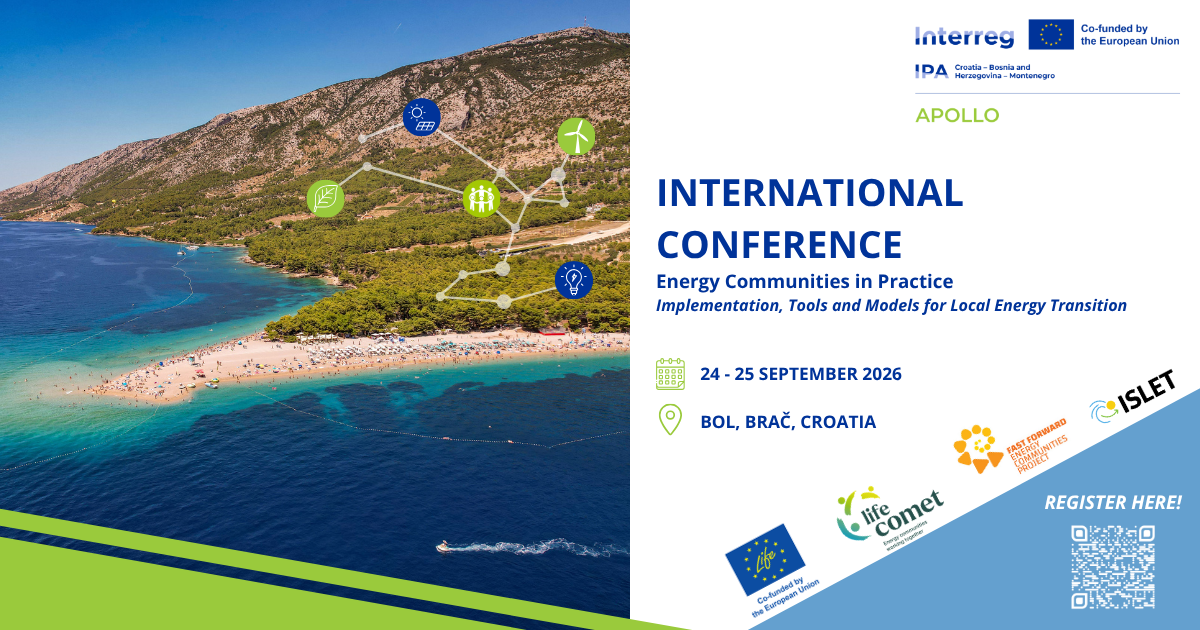
Life COMET is happy to invite you to its final event, taking place in Croatia, on the island of Brač, on 24 and 25 September 2026.
Join us to discuss Energy Communities in Practice and celebrate the achievements of the past three years of the Life COMET project.
With key inputs from the APOLLO, ISLET, Life COMET and DBU/ECF Fast Forward Energy Communities projects, the conference will focus on the Implementation, Tools and Models for Local Energy Transition.
📅Date: 24 – 25 September 2026
📍Venue: Bluesun Hotel Elaphusa, Bol, island of Brač, Croatia
🎤Working languages: Croatian and English, with translation provided
🏛️Organizers: Ministry of Regional Development and EU Funds, Zadar County Development Agency ZADRA NOVA, Green Energy Cooperative – ZEZ and Island Movement
Find the full programme below.
DAY 1 - September 24, 2026
Public Conference Day
Focus of the day: EU programming and financial perspective, Croatian implementation, experiences from the field, decision-makers and the role of the regional and local level in the development of energy communities.
09:30 – 10:00 Coffee check-in
Arrival of participants, registration and informal networking.
10:00 – 10:30 Opening of the conference
- Ministry of Regional Development and EU Funds
- Marina Dujmović Vuković, Director of the Zadar County Development Agency ZADRA NOVA
- Katarina Marčić, Mayor of the Municipality of Bol
- Zlatko Zmijarević, Deputy Chairman of the Board of Directors of HERA (Croatian Energy Regulatory Agency)
10:30 – 11:00 INTRODUCTORY PRESENTATION
From EU pilot projects to feasible models of local energy transition
Aida Liha Matejiček, Head of Unit for Croatia and Romania, Directorate-General for Regional and Urban Policy (DG REGIO), European Commission
11:00 – 11:30 Energy Communities in Practice: Experiences of the APOLLO, ISLET, COMET and DBU/ECF Fast Forward Energy Communities projects
Short presentations of project approaches and key experiences from working with local communities, energy communities, islands and local and regional self-government units. Speakers will present what has been implemented so far, what obstacles have been identified in practice, and what tools, models and recommendations have been developed for further implementation.
- Ivan Zoković, ISLET / Island Movement
- Goran Čačić, COMET i DBU/ECF Fast Forward Energy Communities / ZEZ
- Kristina Mudronja, APOLLO / ZADRA NOVA
11:30 – 12:00 Coffee break and networking
12:00 – 12:10 Regulatory framework for the development of energy communities
- Zlatko Zmijarević, Deputy Chairman of the Board of Directors, HERA
12:10 – 13:30 PANEL 1
From barriers to implementation: what institutions can do to make energy
Do communities come to life?
- Željko Krevzelj, Ministry of Economy, tbc
- Ministry of Regional Development and EU Funds
- Ana Juras, Sector Advisor, Ministry of Environmental Protection and Green Transition
- Luka Balen, Director, Environmental Protection and Energy Efficiency Fund, tbc
- Snježana Blagajac, Tariff Systems and Electricity Market Specialist, HERA
- Boris Dokmanović, Director of the Renewable Energy Sources Sector, HROTE, tbc
- Anton Marušić, President of the Management Board, HEP ODS, tbc
Moderator: Blaženka Leib
13:30 – 15:00 Lunch break and networking
15:00 – 16:15 PANEL 2
Cities, municipalities and counties as drivers of energy communities
- Zadar County Development Agency ZADRA NOVA
- Stipe Čogelja, Deputy Prefect, Split-Dalmatia County
- Marin Gregorović, Mayor, City of Cres, tbc
- Darko Knezović, Expert Advisor for Energy Efficiency, City of Mostar
- Jovan Brinić, Vice President, Municipality of Tivat
- Marija Klisura Franulović, Mayor, Municipality of Lumbarda
Moderator: Blaženka Leib
16:15 – 16:35 Closing and conclusions of the first day
19:00 Dinner
DAY 2 - September 25, 2026
Practical project day
From policy dialogue to practical implementation
Focus of the day: positive practical examples of the establishment and development of energy communities in Croatia, the region and the European Union, with an emphasis on models that can be transferred to other local communities. The program connects the experiences of the members of the Energy Communities Forum in Croatia with examples and tools developed through the APOLLO, ISLET, LIFE COMET and DBU/ECF Fast Forward Energy Communities projects.
Working language: English, with translation into Croatian
10:00 – 10:15 INTRODUCTION TO THE SECOND DAY
From First Initiatives to Operational Energy Communities
A brief review of the most important conclusions of the first day and the presentation of the goals of the practical part conference.
Through the presentation of practical examples of energy communities and initiatives in different stages of development, we will show the different paths that citizens, cooperatives, cities, municipalities and development organizations can take from the initial idea to a concrete energy project.
10:15 – 11:30 Block 1: Energy Communities – Different Development Models, Common Goal
This block will present examples of member organizations of the Forum of Energy Communities in Croatia that show different ways of starting energy communities – from civic investment and cooperative ownership to projects initiated by local governments, islands and existing local organizations. Participants will hear how the initiatives brought together members, secured initial funding, defined the first project and responded to legal, technical and organisational obstacles.
Citizens as Investors: From Raising Capital to the First Owned Power Plant Members
- ZEZ / Energy Cooperative ZEZ Sunce
An example of the organization and implementation of the first citizen energy project that shows that citizens can jointly raise capital and take ownership and management roles in a renewable energy project.
Local self-government as an initiator: energy community of several cities and municipalities
- LAG Sava / Energy Community SAVA
The SAVA Energy Community consists of eight local self-government units of Zagreb County, which makes it a good example of inter-municipal cooperation and joint development of local energy projects.
Island Energy Community: Cities, Citizens and the Local Economy in a Common Energy Model
- OTRA / Energy Cooperative Apsyrtides
The example shows how a local energy cooperative can act as an organizational platform that connects citizens, experts and island institutions and creates preconditions for the development of locally owned projects. Through this example, local authorities show that they can move from the role of supporters to active member of the Energy Community.
From Establishment to Operational Citizen Energy Community
- Energy Community of the Northern Adriatic – EZSJ
How a group of citizens and experts from Rijeka went from the first informal gathering to the registration of the association and obtaining one of the first permits to organize an energy community of citizens in Croatia. Participants will hear first-hand about the experiences of energy sharing, as well as the practical, regulatory and technical steps needed to establish a community whose members want to collectively produce, share and use renewable energy smartly.
A small local project with a large demonstration effect
- REGEA / City of Zabok / DVD Špičkina
The example of the Energy Community DVD Špičkina shows that the energy community does not have to start as a large and complex project, but can develop around an existing local institution and a concrete roof.
11:30 – 12:00 Coffee break and networking
12:00 – 13:00 Block 2: Examples from the region and the European Union
In this block, concrete models from the countries in the neighborhood and the region, developed through the LIFE COMET and APOLLO projects, will be presented. Participants will hear how energy cooperatives, national coalitions, cities, municipalities and regional development agencies connect citizens, public institutions and businesses and develop production, sharing, storage and smart management projects.
Solar School Hrastnik: public institutions, municipality, citizens and private partners in the same community
- FOCUS / Energy Cooperative Zeleni Hrastnik, Slovenia
Solar School Hrastnik is one of the most concrete examples within the LIFE COMET network because it connects public infrastructure, local self-government, citizens and private stakeholders in a common project.
Desmi: How Energy Communities Work Together to Build Service and Advocacy infrastructure
- Desmi – Greek National Coalition of Energy Communities
Desmi was formally established at the end of 2023 as an alliance of energy communities, experts, NGOs and academic organizations, which is why it is very comparable to the development of the Energy Communities Forum in Croatia.
HOW THE LOCAL GOVERNMENT CREATES THE CONDITIONS FOR THE FUTURE COMMUNITY
City of Mostar: Public Investments as the Foundation of the Future Local Energy Community
- Representative of the City of Mostar, Bosnia and Herzegovina
The example shows how by linking investments in solar power plants on public facilities,
Electric mobility and citizen education can be prepared by scenarios for the establishment of energy communities. By using its own buildings and infrastructure as demonstration projects, the city can simultaneously build the knowledge and interest of citizens, entrepreneurs and public institutions to actively participate in the energy transition.
Municipality of Tivat: connecting public infrastructure, island-coastal area and local stakeholders
- Representative of the Municipality of Tivat
The example shows how coastal local government can link investments in renewable energy sources and green mobility with the development of an energy management model adapted to local needs.
13:00 – 14:00 Block 3: Practical laboratory of energy communities, conclusions and next steps
By forming several working groups, participants will apply the knowledge from the previous blocks to specific local situations in a relaxed atmosphere.
- Topic 1: Local self-government as a founder and member of the energy community – public roofs as the beginning of the development of energy communities
- Topic 2: An energy community on an island or in a rural area
- Topic 3: A service point for energy communities
Brač Conclusions – Practical Paths to an Energy Community
In the final part, the conclusions of the discussions by topics will be presented, with the aim of identifying possible practical ways towards the establishment of new energy communities.
14:00 – 15:00 Lunch