

News
Upgrading Toolkit: Practical development of community energy
The life COMET Upgrading Toolkit
How can citizens, communities, and national coalitions find paths to upgrade community energy development?
The LIFE COMET partners have compiled the Community Energy Upgrading Toolkit: a comprehensive guide to help stakeholders strengthen policy frameworks, develop viable business models, and build inclusive, citizen-led energy communities.
The toolkit compiles key European resources, organised into three themes and a series of practical paths, or guiding questions that help different actors find the right tools for their needs.
This blog post series presents a short selection of the tools from the Toolkit recommended by the Life COMET partners.
Theme 2: Practical development of community energy
Once enabling frameworks are in place, the next step for energy communities is to translate ambition into practice. This new theme focuses on the hands-on dimension of community energy development: from designing sustainable business models to ensuring collective self-consumption and energy efficiency. It supports community leaders, cooperatives, and local authorities in finding financial solutions, managing risk, and engaging citizens in renewable energy projects.
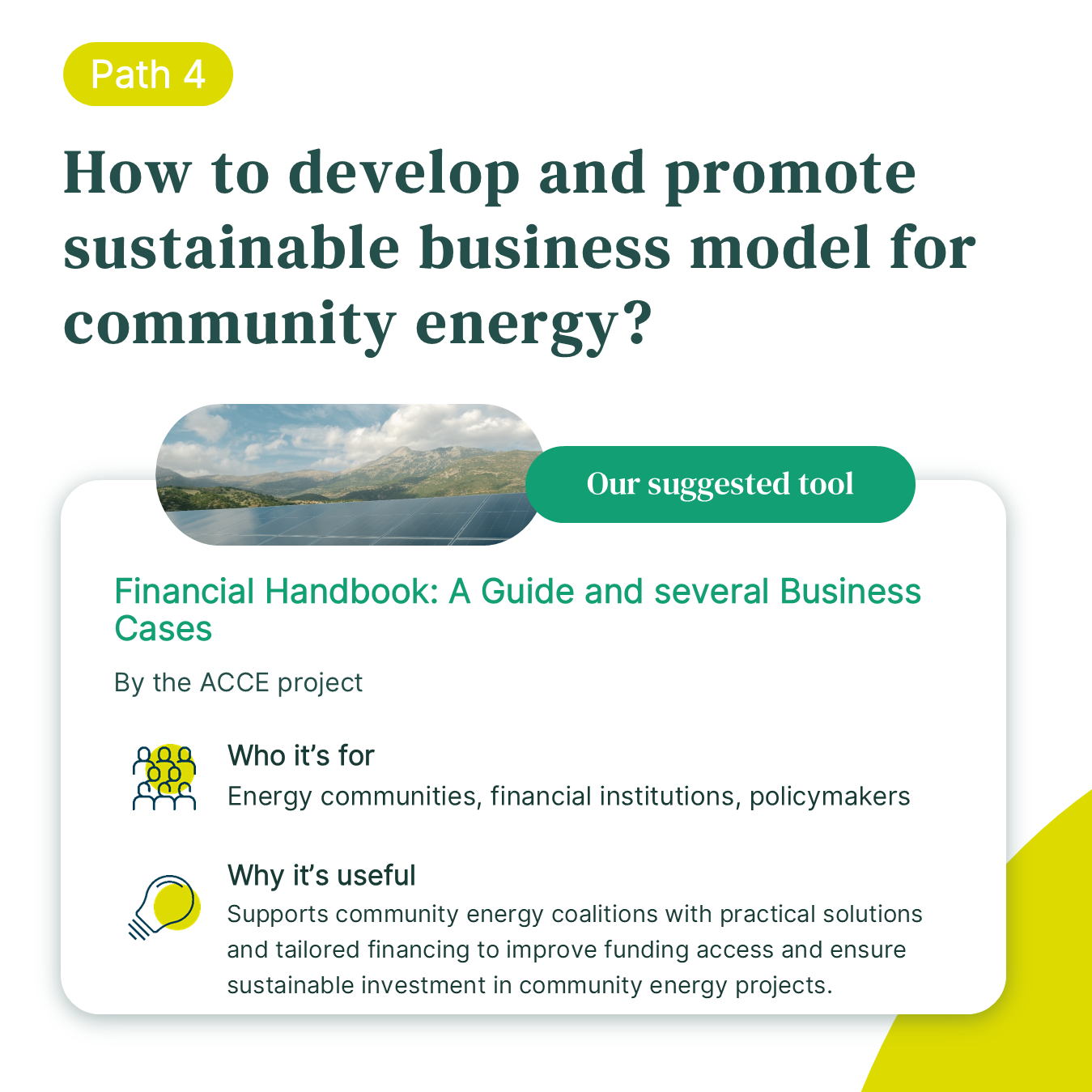
Path 4: How to develop and promote sustainable business models for community energy?
Financial Handbook: A Guide and Several Business Cases
Developed under the ACCE project, this handbook tackles the financial challenges that often hinder community energy development, such as limited access to credit, regulatory complexity, and risk perception among investors.
It introduces Community Energy Financing Schemes (CEFS), presenting grants, loans, and equity investment options adapted to different project stages. By featuring real business cases, the handbook shows how tailored financing strategies can make energy communities more resilient and bankable.
It also highlights the importance of collaboration between public institutions, private investors, and community groups, and offers guidance on aligning financing tools with project maturity. For communities seeking to strengthen their financial model or attract long-term investment, this guide is an essential resource.
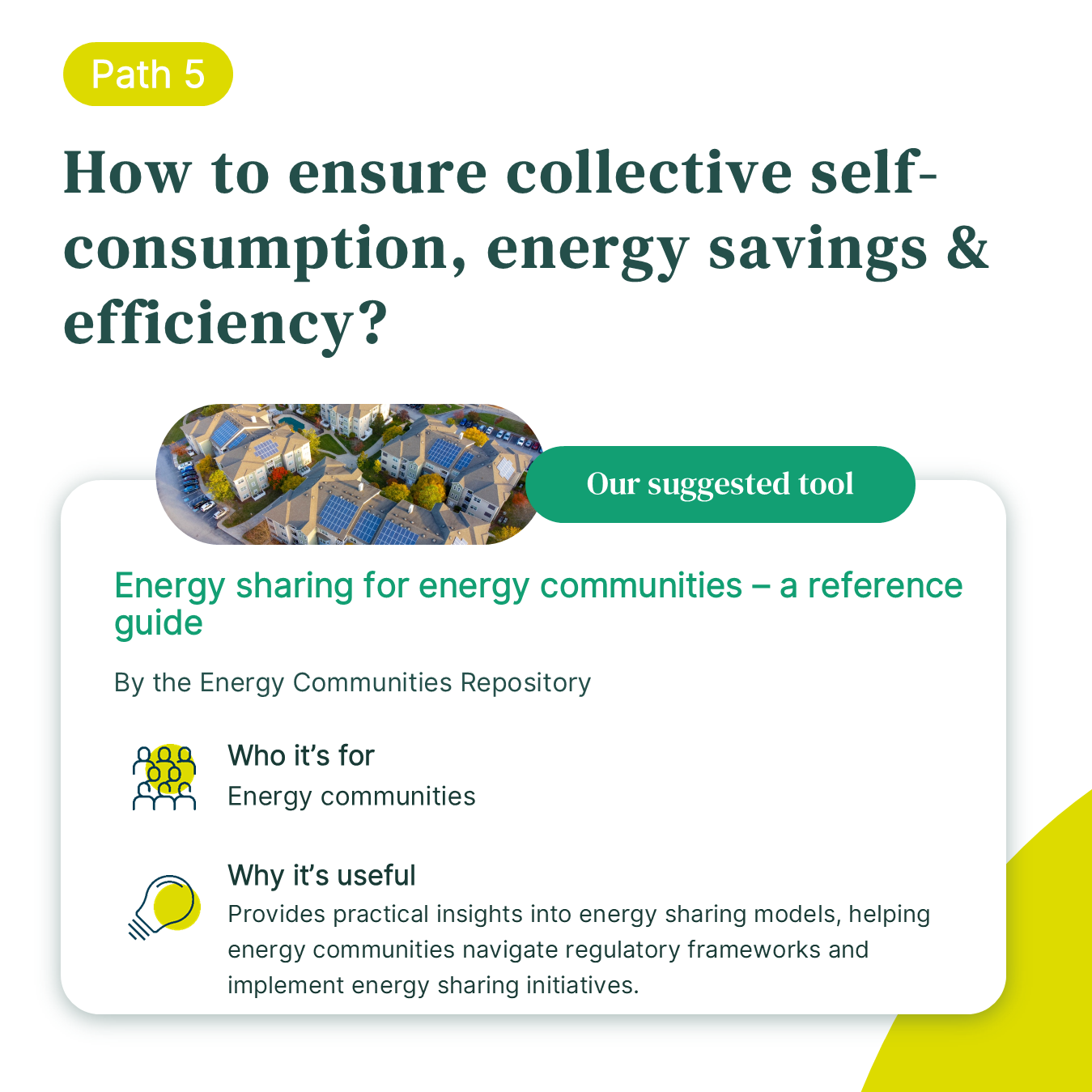
Path 5: How to ensure collective self-consumption, energy saving, and efficiency?
This path in the Toolkit gathers several valuable resources that help energy communities reduce consumption and increase energy efficiency. Among them are the Guidelines on Community Heating and Cooling and the Energy Solidarity Toolkit: Practical Ways for Energy Communities to Tackle Energy Poverty, which provide concrete approaches to supporting vulnerable households and promoting sustainable energy use at community level.
In this blog post, however, we shed light on the topic of energy sharing, a key approach for achieving collective self-consumption and empowering citizens to become active participants in the energy transition.
Energy Sharing for Energy Communities – A Reference Guide
Energy sharing allows citizens and communities to jointly operate renewable energy systems and benefit from the electricity they produce. This guide explains how such models can boost citizen participation, reduce costs, and stimulate local investment in renewables.
It reviews different regulatory and business model approaches across EU Member States, providing insights into how local contexts shape energy sharing. The guide also clarifies key technical concepts such as allocation, matching periods, and optimization rates; thus helping practitioners design and operate energy sharing schemes effectively.
For energy communities ready to move from planning to implementation, this reference guide is a valuable step-by-step resource for building viable, locally tailored collective self-consumption initiatives.
The next blog in this series will explore the third and final theme of the toolkit, Community energy growth, focusing on how to scale and sustain citizen-led energy initiatives across Europe. Stay tuned!