
News
From Resistance to Cooperation: Reflections from the Czech Republic
By Magda A. Domańska, Coop Tech Hub
If you stopped someone on the street in Brno and asked what comes to mind when they hear the word “družstvo,” (cooperative) you probably wouldn’t get an enthusiastic answer. For many older Czechs, the word still carries the weight of the Jednotné zemědělské družstvo (Unified Agricultural Cooperative), the forced collectivisation of agriculture after 1948, when farmers had their land taken from them, first through pressure, then through force. This isn’t distant, textbook history. It’s a memory that has survived three generations in many families.
Yet, the conversation about energy communities in the Czech Republic does not start from scratch. Thanks to the work of organisations like UKEN (The Czech Union for Community Energy), which has been actively supporting and connecting community energy initiatives across the country for the past years, the groundwork for involving citizen initiatives in the energy transition is already underway. UKEN’s experience and growing network of members have been key to pave the way for new projects, proving that despite historical and cultural challenges, the interest for a more collective and locally owned energy system is very much alive in the country.
Harder ground than in Poland?
The Czech citizen energy market is still in its early stages. The energy law amendment known as Lex OZE II formally opened the door for municipalities and residents to set up energy communities, and the technical system meant to support all of this, the Elektroenergetické datové centrum, entered full operation on 1 August 2026, expanding its services to cover accumulation, flexibility, and a so-called network traffic light. Full implementation of all functions is expected to be finished by the end of 2026, so the market is still finding its footing. Parts of the industry pointed to barriers that shielded large energy companies from competition with small communities during the transition period, and critics warned that earlier delays could prove costly, since municipalities decide on renewable energy partners well ahead of time.
On top of that comes something no law can change overnight. Cultural research shows that Czechs have an unusually strong need for certainty and predictability. Distrust of untested solutions runs deep here, and collective decisions tend to take longer than in many other countries in the region. It’s a context shaped by unique historical and cultural factors, which makes the path to energy cooperatives different than in Poland.
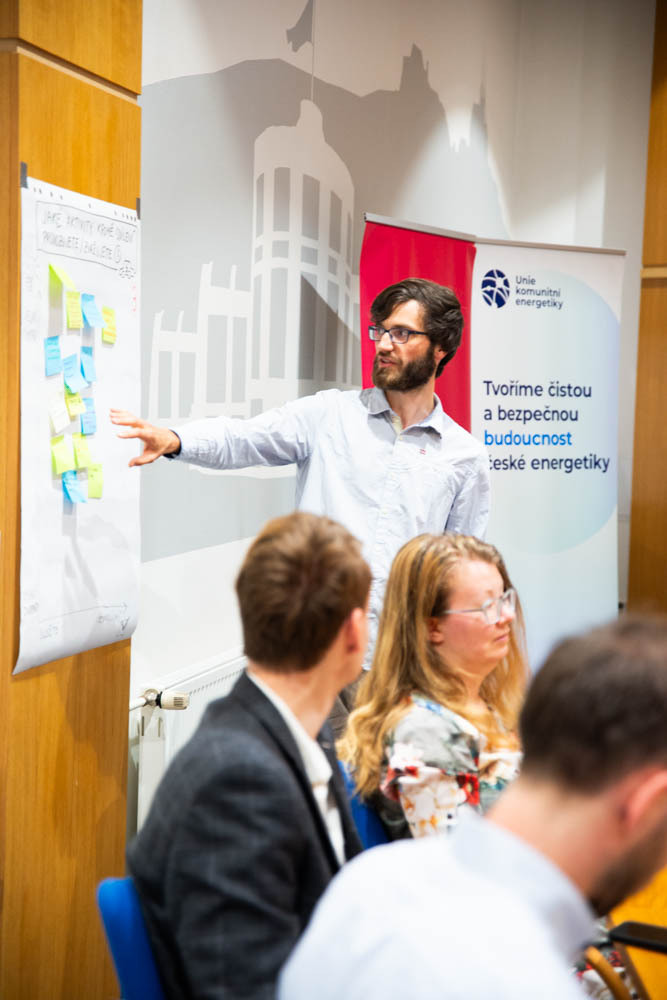
In short, the ground for energy cooperatives seems harder in the Czech Republic than it ever was in Poland. That’s exactly why exchanging good practices and replication ideas, learning from neighbours who have already walked this path, matters so much for the Life COMET partners.
Brno, the URBIS conference, and thirty listeners
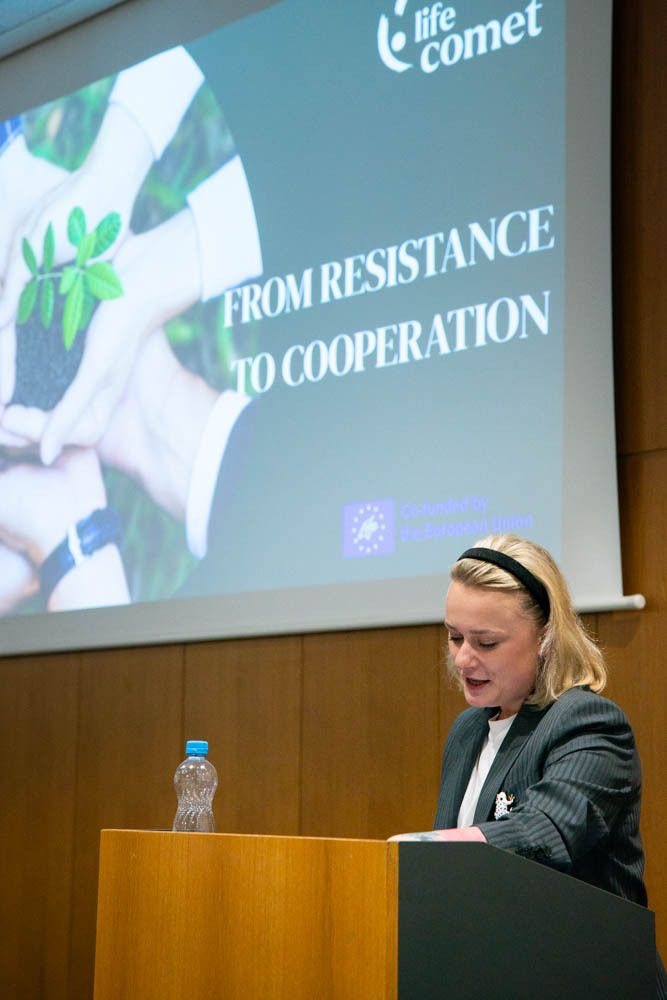
That was the starting point for a talk CoopTech Hub, the Polish partner of the Life COMET project, gave in May at the URBIS conference in Brno, to a room of around thirty people. The event was organised together with UKEN, who was the natural partner for inviting Polish actors into the conversation. The title said it all: “From Resistance to Cooperation.” The question hanging in the air throughout the talk was simple and practical: what actually has to happen for a municipality, or a group of residents, to commit to setting up an energy cooperative?
The answer came from two very concrete stories from Polish municipalities involved in the Life COMET project:
- The first is Radzymin, near Warsaw. There, the push came from the bottom up: a single municipal councillor approached CoopTech Hub herself and asked for an expert presentation at a council session. None of her fellow councillors had any idea what an energy cooperative was. What convinced them wasn’t the idea itself, but the numbers. A detailed analysis showed the municipality already had five solar installations, enough to launch the first stage of a cooperative without any new investment. Savings from that first stage alone come to over 80,000 PLN a year (around 18 000€). That opened the door to the next decision: building a biogas plant, which also happens to solve part of the municipality’s waste management problem.
- The second story is Nadarzyn, where the mechanism ran the other way entirely. The mayor took the initiative before residents even knew it was happening. When the first report landed in front of the council, what caught councillors’ attention most was a passing mention of nuclear power, which says a lot about the level of energy literacy at the starting point. Eighteen months later, the Nadarzyn Energy Cooperative was formally registered, deliberately designed as a pilot without individual residents as members: a model meant to be tested and replicated, not a one-off project.
As different as their starting points were, both stories share one thing. There always had to be someone “on the inside”: a councillor, a mayor, someone the community already trusted and who was willing to carry the idea forward. No outside presentation can substitute for that.
Not finances, but relationships
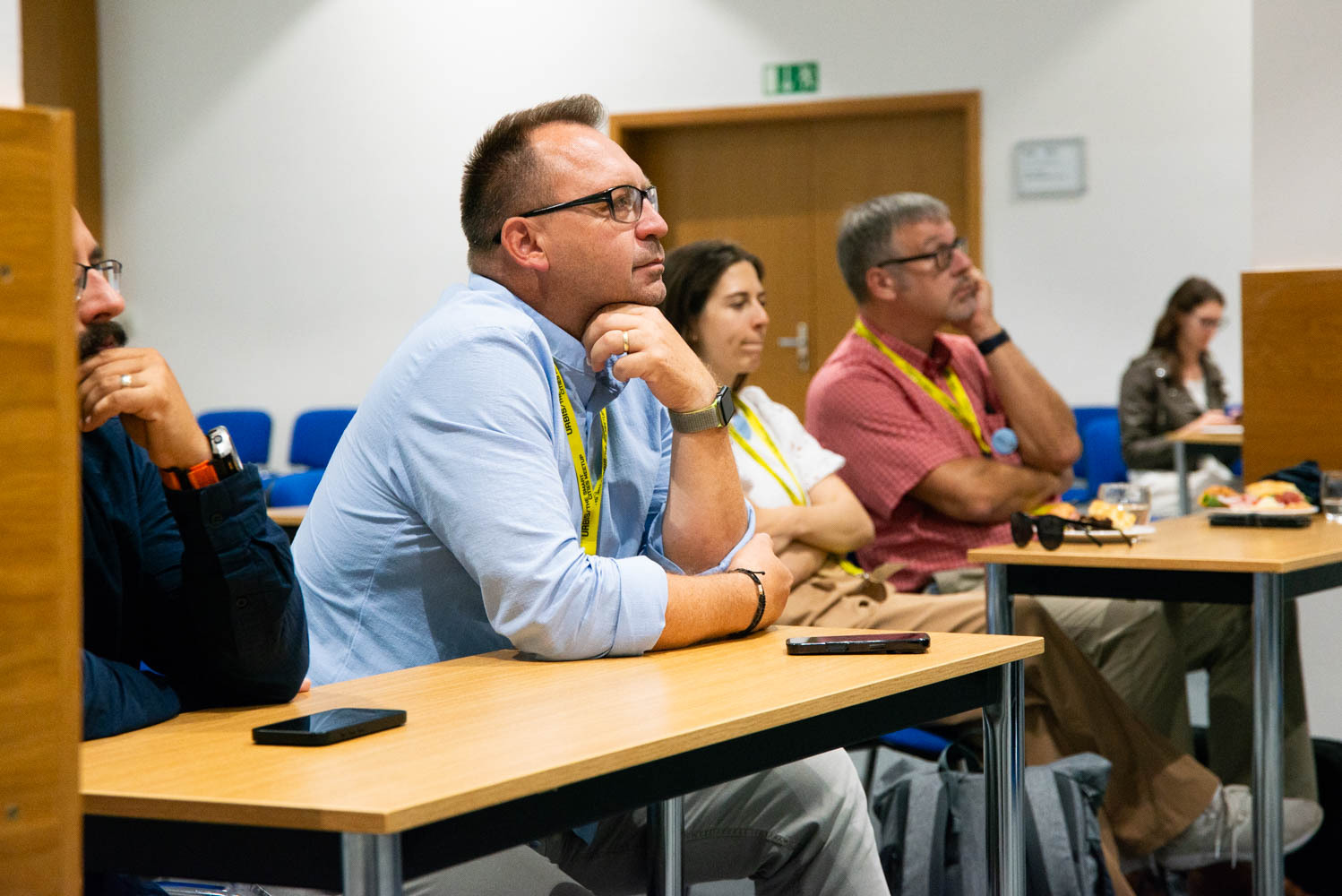
But what did people in Brno actually ask about? Because that was telling in itself. The audience wasn’t so much interested in specific figures or financing models as in how to build relationships and find partners for setting up a cooperative. The question kept coming back in different forms: how to reach the right people in a municipality, how to win over sceptical councillors, how to find common ground with neighbouring initiatives?
According to the Polish experience: networking and steady, ongoing conversation matter more than even the best one-off presentation. You have to keep reaching out to people at every opportunity, return to the subject again and again, and look for allies in places no one expects, agricultural or housing cooperatives, for instance, which already have built-in trust within their own communities. It’s this kind of patient, relationship-driven work, not access to financial data, that ultimately decides whether resistance turns into cooperation.
Why this matters beyond the local level
What happens in a single municipality carries a weight today that goes well beyond one town or one country. Europe is facing a moment where energy security has stopped being an abstract textbook concept and has become an everyday question about prices, about supply, about what happens if the grid fails. The war on the continent’s eastern edge, and years of uncertainty in energy markets, have reminded everyone that depending on a handful of large, centralised energy sources is a risk, not a convenience.
Energy cooperatives, built one municipality at a time, won’t solve that problem on their own. But each one is a small step toward a system that’s harder to destabilise, because it doesn’t hinge on a single point of failure. That’s exactly why projects like Life COMET make sense across borders. The knowledge Radzymin and Nadarzyn earned through trial and error doesn’t have to be learned from scratch in Brno, Sofia, or Jūrmala. It can be passed on, taking local history into account, without anyone having to walk that same long road all over again.
Czech Republic faces a harder start than Poland did: tougher regulation, a deeper-rooted wariness of the word “cooperative,” a history that needs to be reckoned with before anyone can talk about the future. But the mechanism that eventually wins people over is the same everywhere. Find someone others trust, speak in the language of real relationships and facts rather than slogans, and stay present long enough for trust to actually take hold. That’s what CoopTech Hub, together with UKEN, brought to Brno: not a ready-made model to copy, but a map on which others have already marked where the potholes are.